Notes from the Stadium: Where Massachusetts Manufacturing Meets Its Next Chapter
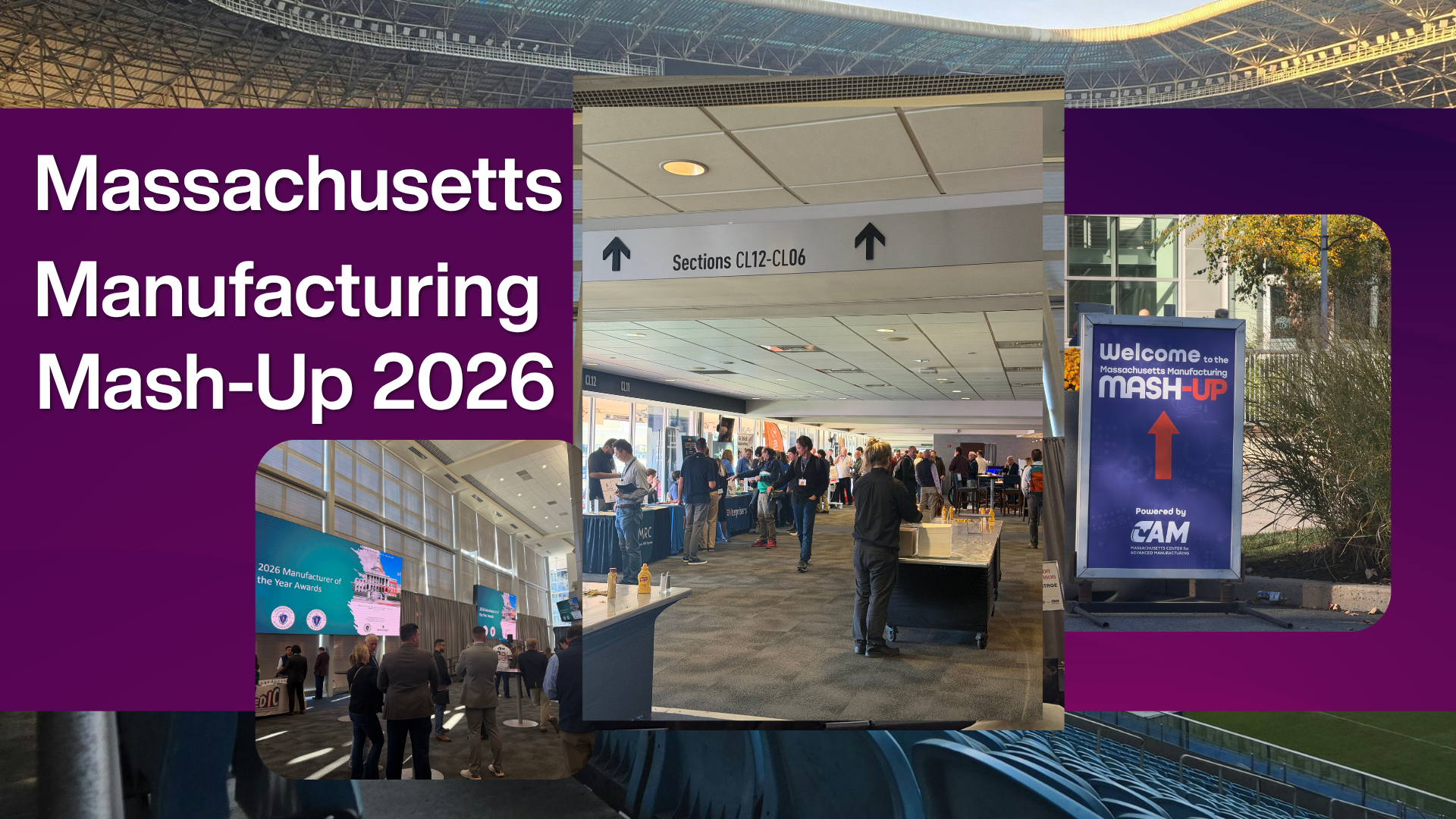
Yesterday, Gillette Stadium brought together machinists, data scientists, plant leaders, engineers, founders, students, and state program teams. The sixth annual Massachusetts Manufacturing Mash-Up, hosted by the Center for Advanced Manufacturing (CAM) at MassTech, filled the concourse from morning coffee to the closing reception. By CAM's count, it drew the most exhibitors and attendees in the event's history, and the state used the stage to announce nearly $10.5 million in M2I2 commercialization grants to 17 manufacturers.
On the exhibitor floor, global corporations, family-owned manufacturers, and startups shared the aisles. Conversations moved easily between compliance, regulations, robotics, marketing, funding, workforce pipelines, and hiring. That mix is the real strength of the state's industrial base: scale and experimentation in the same room.
Pitches built from the main stage
The AI in Manufacturing Pitch Contest featured Corello, Warpcore, Anetix, and Valix, each tackling a different challenge facing manufacturers, from preserving shop-floor knowledge to meeting cybersecurity requirements.
A common thread was the effort to solve problems rooted in day-to-day manufacturing operations. The strongest presentations opened with a cost a plant manager already feels, in hours or dollars, and only then introduced the technology.
Any company selling to industrial buyers can borrow that sequence. Technology may earn attention, but a clear business problem gives buyers a reason to act.
A live test of scale-up instincts
“Can Your Startup Survive Scale-Up? A Live Simulation from Prototype to Production” turned the audience into decision-makers, with a live poll at each stage:
- After a validated prototype: 83% chose a pilot with an early customer in a real production environment. Only 8%, including me, chose a purchase commitment from a customer with an urgent need.
- A $15 million capital requirement: 43% preferred a phased customer order to spread the spending, 34% favored grants and other non-dilutive funding, and 14% chose equity.
- Producing 1,000 units in a year: 97% chose a hybrid model, keeping critical processes in-house and outsourcing the rest.
- First facility: 43% prioritized existing infrastructure so production could start quickly.
A pilot can demonstrate how a product performs in a real production environment. A purchase order provides evidence that a customer is willing to pay, and that can change subsequent conversations with investors, lenders, and grant officers.
One booth worth naming
At the LabyrinthAI booth, I experienced the demo and spoke with founder Michael Healy about the problem the company set out to solve: the best operators know things the work instructions leave out. Delphi, LabyrinthAI's platform for physical AI, launches today. Paired with RoboCapture, it records human demonstrations with synchronized video, voice, and 3D hand motion, then turns them into data robots can learn from.
Congratulations to Michael and the team on the launch.
Coming next
The Mash-Up also showed how much public infrastructure stands behind this sector. The next post covers the organizations doing that work, from the Massachusetts Export Center to MassMEC and MassDevelopment.